
“Memorable, entertaining, engaging” – Apprentice.
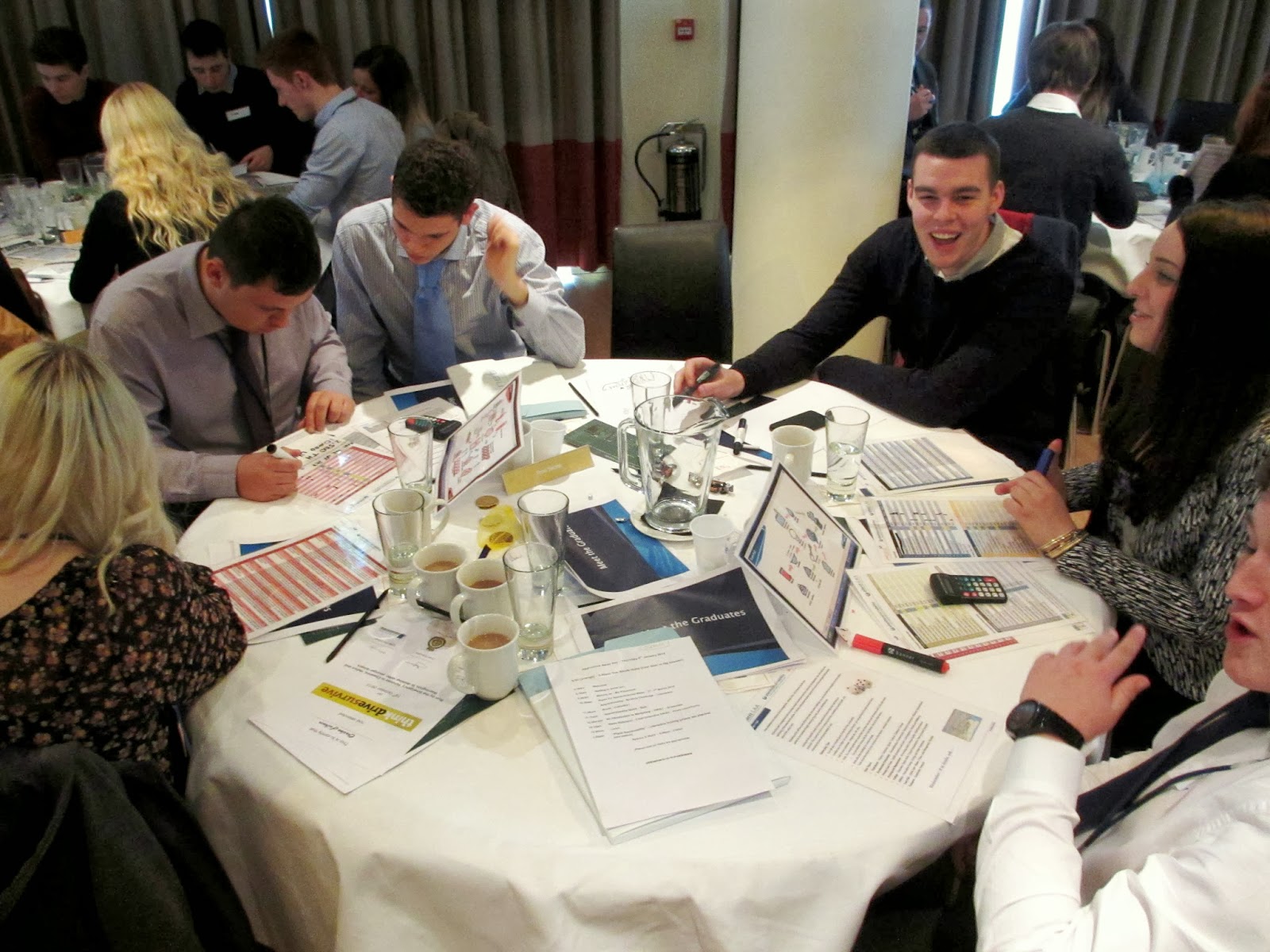
The workshop was based around our learning simulation, Planit-Sustainability. The learning game simulates a community that is in a bit of a poor state. It is the players’ job to turn it around, over several virtual years (rounds). The game is played collaboratively. A team is divided into sub-teams which take on different roles in the community, for example, Town Council, College, Community and Voluntary Sector and so on. The sub-teams need to work together to improve the community and achieve a good score.
“I had never done anything similar before so it was
interesting to see a new way of learning” – Apprentice.
Because of the size of the group, we split the room into two teams and ran two simulations simultaneously. Each sub-team was made up of about two or three people. These teams are given a budget and a report, which changes as a result of their purchase decisions. It is a resource management game, so the main decision-making revolves around how to spend the budget. However, in order to be most efficient and effective, teams must work together for the good of the overall community.
“I enjoy this way of working as it’s engaging and fun. It’s good for
team building as you need to work together” – Apprentice.
team building as you need to work together” – Apprentice.
 The workshop was used as part of an induction day for apprentices of the council. Janice Houghton explained the learning need, “As our Apprentices don’t work as a team they are placed across the authority in different placements, I wanted them to get a real feel for working as a team and experience different personalities etc, also to understand the consequence of their actions.”
“Everyone is more involved and it keeps your concentration up rather than continuously staring
at a screen” – Apprentice.
at a screen” – Apprentice.
The simulation is designed to get people working together, collaboratively and to break down silos. However, the same simulation was used slightly differently in our workshop with Cheshire West and Chester last year. Last year, it was used to develop 21st century skills. The simulation is fantastic at promoting team working, critical thinking, problem-solving, negotiating, prioritising, working with budgets, working to deadlines and so on. It is also excellent in a council as it simulates the running of a community, however, it works well in businesses, schools etc. too. But what makes it so attractive is that it is fun and engaging.
“This way of learning way more memorable” – Apprentice.
Janice explained why she chose games based learning as opposed to other forms of induction, “This is a fun way of learning, our apprentices liked the graphics and being able to see immediately how things changed worked well.”
“They [learning simulations] are much more interesting and
involved than classroom- style learning” – Apprentice.
“They [learning simulations] are an interactive
and fun learning tool” – Apprentice.
and fun learning tool” – Apprentice.
For more about Planit-Sustainability, click here.
For a demo, click here.
For more about our other learning simulations (which can be used in a similar way), click here.
Please follow @paulladley on Twitter, games-ED on Pinterest and like games-ED’s Facebook and Google+ pages for blog updates and interesting games based learning findings.

