Showing posts with label teamwork. Show all posts

Thursday, 27 February 2014

Collaborative Gaming: The Ultimate Case Study

One of the most common ways in which games can be used in an educational environment is for collaborative gaming.  An entire class focusing on one game is far easier to manage or control than many small groups or everyone at a different computer and it also promotes skills such as teamwork or communication.  We have looked at some of the benefits or difficulties involved with this previously but recently an extremely interesting example of collaborative gaming has emerged and, although it isn’t in an educational environment, there are a lot of interesting phenomena that have arisen and we can learn a lot from it in terms of the dynamic of a large group working towards a goal.

A screenshot from TwitchPlaysPokémon - courtesy of http://imgur.com/V9D2Tfi

TwitchPlaysPokémon, whose creator has expressed his desire to stay anonymous, is hosted on twitch.tv, a website more usually used for streaming a game live as you play it, but it has one vital difference: the controls are not entered by one player; they are entered in a chat box to the side of the live video stream of the game.  This means that multiple people from anywhere in the world are in control of the game at any one time and, since it has entered the consciousness of the general public, there are often ten commands being entered in a second and sometimes many more. The game of Pokémon Red (1996) lends itself well to this format; as a strategy game it can be played in an infinite number of ways and it rarely punishes missteps seriously, ensuring a level of unpredictability in progress while also guarding against heavy, demoralising setbacks which would potentially scare off people interested in contributing.  Despite this, it was still expected that some challenges in the game would prove too much for the community at large and it was certainly not expected that they would ever actually finish the game.  However, the combined efforts of the globe’s nostalgia-fuelled gamers have overcome all of the game’s gym battles (the major challenges in the Pokémon series), leaving only the final section of the game and the final boss battles to go.  During the past two weeks or so, there have been moments at which approximately 150,000 people have watched simultaneously, as well as landmark moments showcasing the power that a shared goal and a fun interface can have over a group of people working together.  Of course, there have also been low points and some sections which require a specific sequence of buttons to be pressed can take hours (or in very rare cases, days) to overcome.

How the Group Tackles Issues

Of course, this is the most extreme example possible of a collaborative game; there is probably never going to be another situation where 150,000 people could press the same button on the same game at the same time and it is even more unlikely in an educational environment.  As such, there are some quite major issues with gameplay, but the ways in which the community has reacted to them is enlightening and encouraging.

The first and most obvious of these is that with so many people inputting commands, any section that needs extended precision is almost impossible (such as the dreaded Ledges, which earned their capital ‘L’s).  One of these, a room involving floor tiles that can send you back to the entrance of the room had taken up to 26 hours without any progress.  This motivated the creator to introduce a ‘democracy’ mode, which takes the most popular command over twenty seconds and enacts it, creating precision but it is excruciatingly slow.  This has sparked a backlash from some sections of the community, who believe that democracy mode defeats the point and the game should be completed entirely in the original ‘anarchy’ mode.  The majority of gamers are not particularly concerned about the purity of the experience and so it creates a fascinating phenomenon.  After an obstacle has been impeding their progress for a large period of time, usually several hours, the votes will flood in for democracy mode and they will complete their task before immediately sliding back into anarchy mode so that they can continue the game ‘properly’.

Another problem with the format is that due to the scale, there is a thirty-second lag, rendering many commands obsolete at best and a hindrance at worst by the time there are actually registered.  Again, the hivemind arguably exceeds expectations in dealing with this, often only overshooting targets once or twice before arriving at the destination.  Sometimes, when preparing for big events, the community organises itself via the forums and chat facilities and is capable of entirely pre-empting the lag.  This shows an impressive level of communication, given that hundreds, potentially thousands, of people are entering commands for something they won’t see for another thirty seconds.

Both of these demonstrate an innate desire to progress and to achieve.  The gut reactions of most contributors is to do what is best for the communal goal and it is heartening to see people automatically working together without instruction, although since this is accessible to anyone on the Internet, there are of course a small number of trolls whose sole purpose is to disrupt the game, an extremely easy task when a single disruptive command can halt progress.  However, even more impressive heights have been reached.  Pokémon is a strategy game and as more progress has been made, some members of the community have considered and developed their strategies to deal with both the actual game and the control system.  They show independent research (e.g. finding and distributing this map), critical thinking and even presentation skills as they develop methods to beat certain parts of the game (taking into account the unusual challenges presented by the format), before presenting their findings to the community at large via chats and forums, often in the form of an annotated document or map.  The input format is effectively a vote: if enough people approve of the suggestion they will attempt to enact it and will eventually overpower the others.  There have been suggested strategies which have been considered, rebutted and then ignored and there have been strategies which on the face of it seem counter-intuitive but have been enacted, showing that the majority of the community has a high level of communication.  Astonishingly, there has even been what must be a rare example of organised trolling, when a group of trolls worked together in an ultimately unsuccessful attempt to render the game unwinnable at one of very few points where this is possible.

Community

When watching the stream and following the chat, it is possible to get a sense of a cross-section of the players’ mentalities and the way they play.  There are a few clear types of regular players, some of which mirror player types we have discussed before on the topic of MMO games.  Using this article as a guide, we can clearly identify Socialisers and Philanthropists.  There are many people who are playing for social reasons, and in fact the meme culture which has rapidly sprung up around this game is impressively diverse and being added to with playful faux-religious fervour.  It is arguably the star of the show and almost certainly the main reason people have not lost interest is due to the narratives and binding references being constructed as they go along.

In fact, it is extremely difficult to identify anyone playing solely for achievement’s sake, like the Player type in the cited article.  There are some players whose main goal is progression but they still have in mind the social aspect and also the chaos with which this game began, as shown by the immediate regression to anarchy once democracy has served its purpose.  I would add a couple of new types: Purists, who are devotees to the anarchy system and believe that it should be adhered to at the cost of progress; and of course, Trolls, whose main goal is the disruption of the game.  It seems as though all players have purity in mind but as frustration over a specific obstacle grows, we often see them drift towards democracy to facilitate progression.  Purists are the players who staunchly vote anarchy even at this point and could be considered similar to the Free Spirit as they put their personal journey ahead of the collective desire.  However, they are not necessarily hugely creative either so I consider them different.

Fan-made art inspired by the game - courtesy of http://imgur.com/F5NA7RK

Lessons for Educational Games


While this specific format has major problems blocking it from use in education, it could be used with tweaks and editing.  Without being actually used, it still has lessons to be learned with regard to group dynamics.  We can see that when left to their own devices with a goal to achieve, a group of people will work towards a common goal, strategise to overcome more difficult obstacles, and implement rudimentary democracy to make contested decisions.  Ultimately, it may not even be necessary for a game to have any educational content; children (and some adults) could learn those valuable lessons from this exact game.  On top of this, the fictional world and characters facilitate the creation of the culture and memes that surround the game, which glues the community together and promotes discussion and sharing ideas.  Oftentimes, games where learning is spontaneous can be more powerful than when learning is explicit and can feel forced.  For a game to be used educationally, it doesn’t have to be designed with education in mind.  Any game can be an educational game, it just depends what you want to teach.


Please follow @paulladley on Twittergames-ED on Pinterest and like games-ED’s Facebook and Google+ pages for blog updates and interesting games based learning findings.


Tuesday, 11 February 2014

Inspiring Apprentices with Games Based Learning

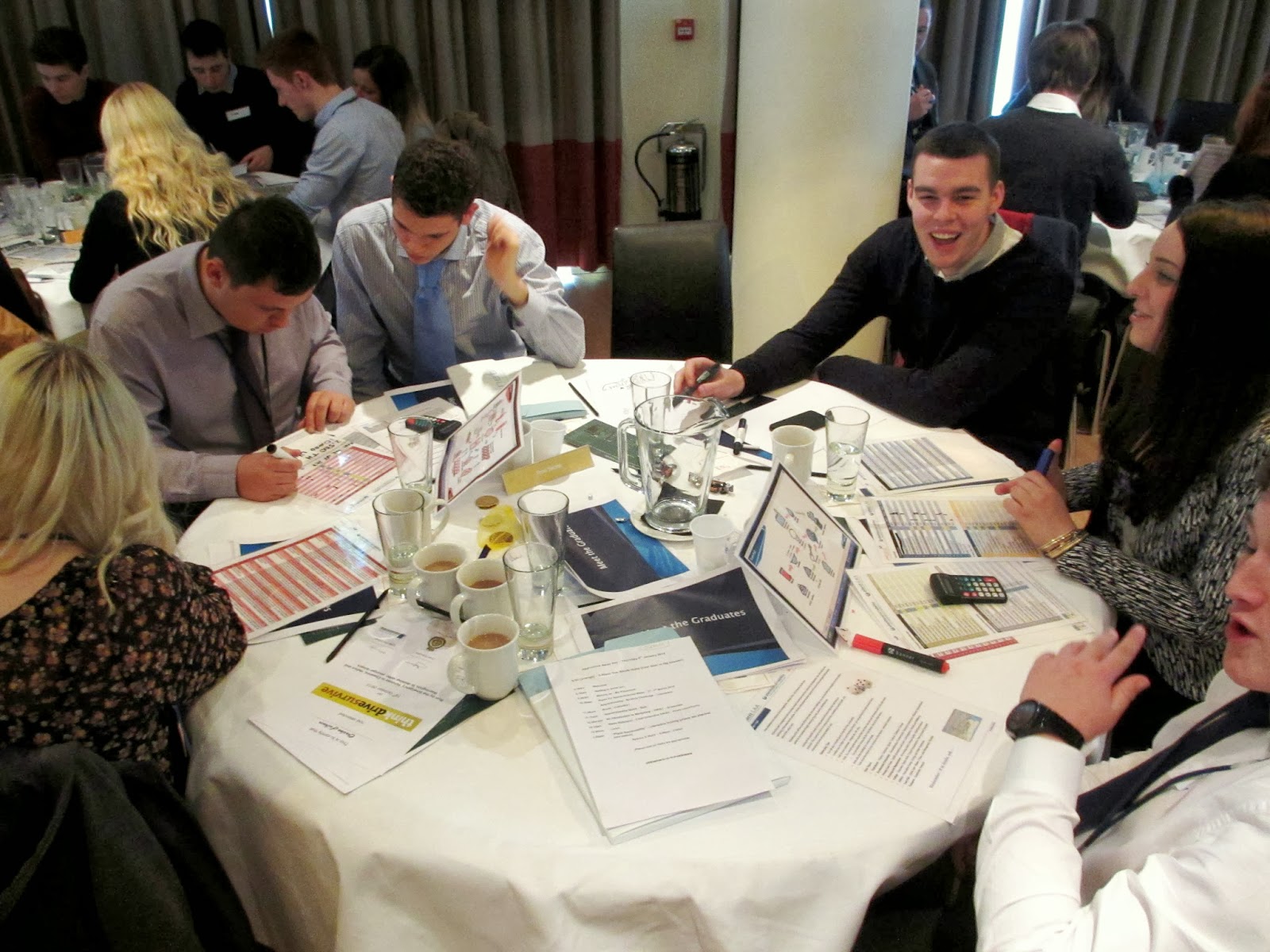
In January of this year, pixelfountain was asked to hold a games based workshop as an induction for around 40 apprentices of Cheshire West and Chester Council (North West England).  We decided to blog about the day to give you all an insight into what we do.  We also gathered some feedback from the apprentices themselves and Janice Houghton, Employee Development Officer, who asked us to come in last year and again this year.  These are very interesting, in terms of the merits of games based learning and its uses.

“Memorable, entertaining, engaging” – Apprentice.

The workshop was based around our learning simulation, Planit-Sustainability.  The learning game simulates a community that is in a bit of a poor state.  It is the players’ job to turn it around, over several virtual years (rounds).  The game is played collaboratively.  A team is divided into sub-teams which take on different roles in the community, for example, Town Council, College, Community and Voluntary Sector and so on.  The sub-teams need to work together to improve the community and achieve a good score.

“I had never done anything similar before so it was 
interesting to see a new way of learning” – Apprentice.

Because of the size of the group, we split the room into two teams and ran two simulations simultaneously.  Each sub-team was made up of about two or three people.  These teams are given a budget and a report, which changes as a result of their purchase decisions.  It is a resource management game, so the main decision-making revolves around how to spend the budget.  However, in order to be most efficient and effective, teams must work together for the good of the overall community.

“I enjoy this way of working as it’s engaging and fun.  It’s good for 
team building as you need to work together” – Apprentice.

The workshop was used as part of an induction day for apprentices of the council.  Janice Houghton explained the learning need, “As our Apprentices don’t work as a team they are placed across the authority in different placements, I wanted them to get a real feel for working as a team and experience different personalities etc, also to understand the consequence of their actions.”

“Everyone is more involved and it keeps your concentration up rather than continuously staring 
at a screen” – Apprentice.

The simulation is designed to get people working together, collaboratively and to break down silos.  However, the same simulation was used slightly differently in our workshop with Cheshire West and Chester last year.  Last year, it was used to develop 21st century skills.  The simulation is fantastic at promoting team working, critical thinking, problem-solving, negotiating, prioritising, working with budgets, working to deadlines and so on.  It is also excellent in a council as it simulates the running of a community, however, it works well in businesses, schools etc. too.  But what makes it so attractive is that it is fun and engaging.

“This way of learning way more memorable” – Apprentice.

Janice explained why she chose games based learning as opposed to other forms of induction, “This is a fun way of learning, our apprentices liked the graphics and being able to see immediately how things changed worked well.”

“They [learning simulations] are much more interesting and 
involved than classroom- style learning” – Apprentice.

The day was great fun.  It got everyone engaged, moving, talking and thinking.  When asked about the outcome of the day, Janice responded, “Everyone enjoyed the session and remained engaged, it was a bit confusing at first but when they realised how it worked the team spirit kicked in and they all wanted to win.”  And in terms of the learning need, the feedback obtained from the apprentices suggests that the workshop really worked.  For example, “I learnt the value of communication and teamwork”, “[I learnt] how to work with others and how to solve problems”, “[I learnt about] the way things affect other things” and “[I learnt] how to work in a team to achieve better outcomes”.

“They [learning simulations] are an interactive 
and fun learning tool” – Apprentice.

For more about Planit-Sustainability, click here.

For a demo, click here.

For more about our other learning simulations (which can be used in a similar way), click here.

Please follow @paulladley on Twittergames-ED on Pinterest and like games-ED’s Facebook and Google+ pages for blog updates and interesting games based learning findings.

Friday, 17 January 2014

Why Organisational Gamification was Inevitable and Not a Fad

I believe that there are several factors which made Gamification of organisations inevitable.  It is often
criticised for being a fad.  I think that there are some aspects of it which could be.  For example, the dreaded ‘badges and leader boards’ definition of Gamification is unbelievably limiting and that aspect might be short-lived.  However, there are elements of Gamification which represent the larger economy, general opinion and the direction for organisations into the future.  It is something much deeper than superficial badges (although they have their merits too).  This is what Gamification should be understood as, what should be taken from games and it is happening right now.

First, the power of gaming as a medium is growing.  The ‘games cause violence’ pack is dwindling, just as it did for every new entertainment medium before (television, radio etc.).  Gamers are not geeky, social outcasts; everyone can be a gamer and many are.  Games are going mobile, casual and social.  Games are big business and on the rise.  If you are interested in the stats, get your fill from PWC here.  I am sure you are all aware of the huge success of Grand Theft Auto Five.  The game made $1 billion in the first three days of being sold.  The fastest film to reach the $1 billion mark was The Avengers, in 19 days.  Games are big news and it is inevitable that they would have an influence over other aspects of our lives.

Second, Gamification has evolved from 21st century organisational needs.  In some cases it has slipped in unnoticed, in other cases it as added an extra twist to an existing management trend.  There are ways that Gamification is relevant today, inevitable and not a fad and the points below show why this is the case and what organisations should be taking from games and translating into Gamification:

  • Feedback – games allow constant feedback and Gamification can be used in this way.  This fits with other organisational trends, such as the breaking down of communication barriers across the organisation, at different levels.  It also allows the organisation to exert control and monitor, but in a constructive way that is more carrot than stick.  It also marries up with Generation Y’s need for constant feedback as they move into organisations (see ‘Motivating Generation X and Y with Gamfication’).
  • Competition – games can promote competition, against others but also yourself.  Players are able to see feedback about how they performed and strive to better this performance.  This can be a powerful use of Gamification.  Businesses need to remain competitive.  Especially in a recession and when innovation and market dynamism are so powerful.  Encouraging competition within the workforce, giving employees more autonomy and allowing them to self-monitor can help this process along.  Gamification is therefore, a natural and fun progression of this.
  • Teamwork – A lot of games and Gamification promote and facilitate teamwork.  There has been a huge move to making use of teams in organisations due to their self-management, innovation and so on.  Teams are a part of the ‘Japanisation’ of the Western organisation.  Gamification, therefore, can be seen as an extension of this, a means to promote collaboration and cooperation.
  • Learning and Development – Organisations have come to appreciate the power of their human resources, especially in terms of their capacity for good ideas, creativity and innovation.  They, therefore, want their employees to be lifelong learners and to constantly develop their skills and expertise.  Organisations can no longer promise to offer a ‘job for life’, so they have moved to support employees’ employability.  Games require constant learning and development of skills and Gamification could be the next frontier for this in organisations.
  • Creativity – Games are fantastic for generating creative problem-solving and innovative thinking.  They require it and reward it.  These skills are needed for 21st Century businesses to survive and thrive.  Therefore, Gamification should be used to reflect and encourage this.  See our post, '21st Century Skills and Games Based Learning'.
  • Change and Flexibility – Games often require the player to be adaptable to change.  The current economic climate and dog eat dog nature of capitalism means that the business world is extremely chaotic and dynamic.  Employees and organisations need to be responsive, flexible and welcoming of change.  Gamification could be great at encouraging this outlook and culture amongst organisations.
  • Fun – There is a move to make work more fun.  Organisations are now more aware of the benefits of a ‘carrot’ approach to motivation, as well as the creative benefits of having a fun office.  For example, Google offices have slides, scooters, lava lamps, pianos and so on, all designed to promote creativity, collaboration and innovation (as well as keeping people at work longer and feeling they owe the organisation).  Generation Y also work to fund their lifestyle as this is the most important motivator for them.  So organisations try to bring this ‘lifestyle’ into work.  They are motivated by something more than the money itself.  These things also represent youth and dynamism, which are championed by many organisations.  The Gamification of spaces and processes at work is probably the most apparent usage.

I study management and organisations, so this area as well as GBL and Gamification interest me greatly.  It strikes me that Gamification embodies many of the directions that management is taking in the 21st Century.  The fact that we now have a name for it doesn’t make it a fad.  The term Gamification has more scope than badges and leaderboards and many game-like elements have been translated into management.  Organisations might not see how games can help them yet.  But, with the growing strength and following of games as an entertainment and learning medium, I don’t think it will be too long until they catch on.  This could be just the beginning for Gamification.

Please follow @paulladley on Twittergames-ED on Pinterest and like games-ED’sFacebook and Google+ pages for blog updates and interesting games based learning findings.