The blog looks at gamification, g-Learning and games based learning theory and practice. It provides insight (via games-ED and pixelfountain) on games based learning use in education and g-Learning (including learning simulations) use in adult learning / training such as application in curriculum delivery, training, awareness raising, organisational development, communications and engagement.
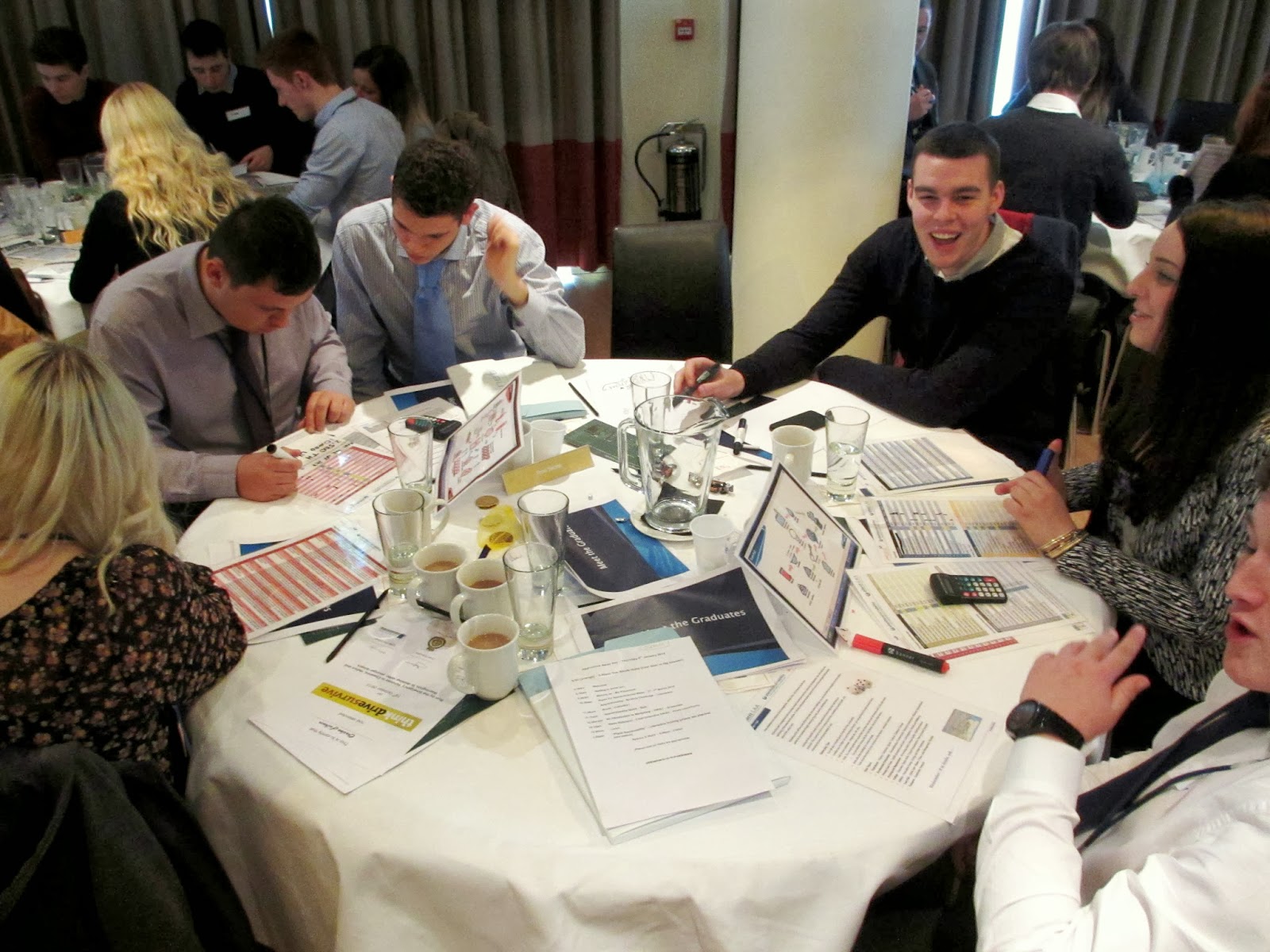
In January of this year, pixelfountain was asked to hold a games based workshop as an induction for around 40 apprentices of Cheshire West and Chester Council (North West England). We decided to blog about the day to give you all an insight into what we do. We also gathered some feedback from the apprentices themselves and Janice Houghton, Employee Development Officer, who asked us to come in last year and again this year. These are very interesting, in terms of the merits of games based learning and its uses.
“Memorable, entertaining, engaging” – Apprentice.
The workshop was based around our learning simulation, Planit-Sustainability. The learning game simulates a community that is in a bit of a poor state. It is the players’ job to turn it around, over several virtual years (rounds). The game is played collaboratively. A team is divided into sub-teams which take on different roles in the community, for example, Town Council, College, Community and Voluntary Sector and so on. The sub-teams need to work together to improve the community and achieve a good score.
“I had never done anything similar before so it was
interesting to see a new way of learning” – Apprentice.
Because of the size of the group, we split the room into two teams and ran two simulations simultaneously. Each sub-team was made up of about two or three people. These teams are given a budget and a report, which changes as a result of their purchase decisions. It is a resource management game, so the main decision-making revolves around how to spend the budget. However, in order to be most efficient and effective, teams must work together for the good of the overall community.
“I enjoy this way of working as it’s engaging and fun. It’s good for team building as you need to work together” – Apprentice.
The workshop was used as part of an induction day for apprentices of the council. Janice Houghton explained the learning need, “As our Apprentices don’t work as a team they are placed across the authority in different placements, I wanted them to get a real feel for working as a team and experience different personalities etc, also to understand the consequence of their actions.”
“Everyone is more involved and it keeps your concentration up rather than continuously staring at a screen” – Apprentice.
The simulation is designed to get people working together, collaboratively and to break down silos. However, the same simulation was used slightly differently in our workshop with Cheshire West and Chester last year. Last year, it was used to develop 21st century skills. The simulation is fantastic at promoting team working, critical thinking, problem-solving, negotiating, prioritising, working with budgets, working to deadlines and so on. It is also excellent in a council as it simulates the running of a community, however, it works well in businesses, schools etc. too. But what makes it so attractive is that it is fun and engaging.
“This way of learning way more memorable” – Apprentice.
Janice explained why she chose games based learning as opposed to other forms of induction, “This is a fun way of learning, our apprentices liked the graphics and being able to see immediately how things changed worked well.”
“They [learning simulations] are much more interesting and
involved than classroom- style learning” – Apprentice.
The day was great fun. It got everyone engaged, moving, talking and thinking. When asked about the outcome of the day, Janice responded, “Everyone enjoyed the session and remained engaged, it was a bit confusing at first but when they realised how it worked the team spirit kicked in and they all wanted to win.” And in terms of the learning need, the feedback obtained from the apprentices suggests that the workshop really worked. For example, “I learnt the value of communication and teamwork”, “[I learnt] how to work with others and how to solve problems”, “[I learnt about] the way things affect other things” and “[I learnt] how to work in a team to achieve better outcomes”.
“They [learning simulations] are an interactive and fun learning tool” – Apprentice.
There are many characterisations of the skills that are most important in the 21st century. However, The University of Melbourne’s Assessment and Teaching of 21st Century Skills (ATC21S) team defines them as:
Ways of thinking. Creativity, critical thinking, problem-solving, decision-making and learning
Ways of working. Communication and collaboration
Tools for working. Information and communications technology (ICT) and information literacy
Skills for living in the world. Citizenship, life and career, and personal and social responsibility
I wanted to share with you a fantastic infographic that further ‘debunks’ some gamer myths, followed by some other interesting facts and figures. Hopefully these will help to convince people (especially parents) that games aren’t all bad and can actually do a lot of good. And some of the facts suggest that most parents actually do appreciate this. Hopefully the education system isn’t far behind…?
This article contains many interesting gamer facts, but some stick out in particular:
68% of parents believe that game play provides mental stimulation or education
57% believe games encourage their family to spend to time together
54% believe that game play helps their children connect with their friends
61% of surveyed CEOs and CFOs are playing games during their working hours
46.6% of surveyed German employees playing games during working hours: daily, 10.0%; several times a week, 15.5%; once a week, 7.0%; once per month, 3.6%; less than once per month, 10.6%
Average age of gamers in years: 37 (has also been playing for average of 12 years)
% of female gamers: 42 (In fact, women over the age of 18 represent a significantly greater portion of the game-playing population (37 percent) than boys age 17 or younger (13 percent).)
% of gamers older than Fifty (2011): 29 (an increase from 9% in 1999)
Percent of gamers who play games with other gamers in person: 65
91% of the time parents are present at the time games are purchased or rented.
There is a reasonable amount of research into motivation at work being undertaken these days and it is interesting to see where gamification fits into the picture. A recent study from Odgers Berntson and Cass Business School suggests that organisations are unprepared for the new generation of leaders. Richard Boggis-Rolfe, Chairman of Odgers Berndtson argued "The retirement of the current generation of corporate leaders will lead to cultural changes that most organisations are unprepared for. In order to thrive in the post-baby boomer landscape, companies need to put serious thought and effort into smoothing the intergenerational transition for leaders from generations X and Y."
But Who are Generations X and Y?
Jane Sunley, CEO of Purple Cubed (a consultancy firm specialised in workplace engagement) explains, “The baby boomers are the generational cohort born between 1945 and around 1961, generation X were born between around 1962 and 1981 and generation Y from around 1981 to 2001… Don’t get too hung up on the dates though, because everybody says that they’re different. The important thing is to appreciate that every generation has been influenced by the environment of their upbringing: education, parents and – in the case of generation Y – the biggest influence has been technology.”
What are the Key Differences Between the Generations?
According to Sunley, there are five key differences between the upbringing, character and motivations of each generation that affect their working styles:
Reason they work – Baby boomers ‘live to work’, generation X ‘work to live’ and generation Y work to fund their lifestyle.
Decision-making – Baby boomers prefer to make their own decisions, generation X will take direction but then like to be left to get on with it and generation Y require constant direction and collaboration.
Feedback and response to work – Baby boomers know when they have done a good job, generation X like regular feedback and generation Y need constant feedback.
Sharing opinions – Baby boomers like to keep their opinions to themselves, generation X share their opinions and generation Y assume others want their opinions.
Attitude to change – Baby boomers are resistant to change, generation X relish change and generation Y are flexible.
Could This Cause Problems?
According to the Cass Business School study, “Only 41% of respondents believed that their organisations are ready for changing workplace demographics of age, gender and diversity.” Many respondents to the study also commented that “the retirement of baby boomers from leadership positions would result in a mass exodus of talent over the next 20 years, which will intensify the global war for talent among existing executives”.
Obviously organisations will have to adapt their leadership strategies, corporate culture and so on to adjust to the new generations of leaders and workforce as well as the 21st century as a whole. Sunley argues that understanding the differences between the generations could give organisations the edge when managing the shift in their workforce. Appreciating the five key differences could help directors form a more effective leadership strategy.
How Should Leadership Styles be Adapted?
The Cass study suggested that, “Foremost among the new leadership skills will be emotional intelligence, people skills and flexibility, which will be needed to attract and motivate a more diverse and mobile workforce… This more collaborative form of leadership will be key to helping executives navigate the 21st Century workforce.”
Professor Cliff Oswick, Cass Deputy Dean, believes, "The increasing diversity of the global workforce will need to be taken into account by corporate leaders. Cultural awareness will be at a premium and leaders will have to cultivate emotional intelligence and be better attuned to gender differences."
What About Gamification?
I have been reading about this topic over the past week or so and it struck me that gamification looks like another way that organisations are coping with some of these new generational styles as well as the 21st century world of work as a whole. The likes of Google are creating new ‘gamified’ offices that cater to the often young, innovative, creative types that they wish to attract and motivate. They often include things such as gyms, gourmet cafeterias, dogs, hair stylists, scooters, massage parlours, slides, shops and so on to support the lifestyle and motivational needs of generation Y (amongst other things).
The fact that generation Y like to work together and collaborate is often encouraged by gamified solutions as well as new office spaces. Rewards for collaboration can be encouraged by team leader boards, badges etc. as well as collaborative games being used to train, assess, build teams and so on. ‘Gamified’, 21st century offices also support generation Y’s need for collaboration. For example, offices are often made with areas specifically for people to bump into each other or act as the proverbial water cooler and encourage people to spark off one another and innovate. Many offices now create open plan areas with smaller pods or seating areas within them to make collaboration natural, easy and fun. For example, white board walls, pianos, ping pong tables and so on are often included in new offices to promote team bonding and collaboration.
Perhaps most strikingly, gamification is a way that generation Y can receive immediate feedback. Members of generation Y are likely to have been brought up around video games and to have amassed a lot of hours playing them. Games offer immediate feedback which could be why generation Y come to expect it from every aspect of life. Gamification can allow immediate feedback to occur and give employees a virtual ‘pat on the back’ for completing actions. This would be time consuming for their managers or peers to do and may not come naturally to them (especially if they are baby-boomers).
Communications (internal and external) and Marketing - see articles here and here.
Rewards, incentives and recognition – e.g. Badgeville.
The cultivation of a specific corporate culture – see article.
Motivation is extremely important at work, both for the employees and the organisations. The infographic below sums up very well how generations X and Y might be motivated differently to the baby boomers and how gamification can be utilised to engage and motivate the workers of today and tomorrow.
For a long time, many people have assumed that ‘gamers’ are unsociable, loners with poor social skills who reside in their dark bedrooms, only venturing outside to fulfil their basic needs. However, research shows that this is far from the truth.
Some research does indicate that playing first person shooters such as Halo and Call of Duty does impact negatively on the players’ relationships. However, that seems to be more to do with the way that people play games than the games themselves. Research from Benjamin Hickerson at The Pennsylvania State University has found that some gamers play the game primarily as a way to reinforce social bonds. In-game features such as cooperative modes and multiplayer options make playing games socially both easy and attractive. The research shows that among this group of social game players, the games help build social ties and enhance social support.
Hickerson’s research suggests that indicators, such as the amount of time and money spent on games, are not related to gamers’ success in maintaining social ties. He argues that “Players may actually be doing something positive when gaming becomes a way for games to connect with friends who they otherwise may not be able to spend time with, especially friends who they are not near geographically.”
Hickerson’s study measured centrality (the need to organise ones’ life around the activity) against social bonding. ‘Centrality’ scores indicated that on the whole, peoples’ social lives were not adversely affected by gaming, although there were a minority that were implicated. However, Hickerson believes that games may be able to help. He argues that this information could help video game designers create games that identify socially problematic behaviours (i.e. excessive centrality) and include features in the games that help the players maintain friendships and relationships.
But do games not already do this? As well as playing in cooperative and multiplayer modes as I mentioned earlier, experts believe that MMORPGs (Massively Multiplayer Online Role Playing Games), may actually “promote sociability and new worldviews.” Experts have described these virtual worlds as a new kind of ‘third space’ (a place for social interaction and relationships, outside of home and work). For many people, they are the preferred way of meeting and hanging out with people, when in the past they may have gone to the pub or to a café. The study titled, “Where Everybody Knows Your (Screen) Name: Online Games as ‘Third Places.’” suggests that the cause of this phenomenon is the lack of real-world hangouts.
In these games, people can hold multiple real-time conversations using text or their voices through microphones. The study explains that this can enable them to build “relationships of status and solidarity.” Often, the games reward people for creating long-term relationships and lasting player ‘guilds’ and it can be difficult to play some MMORPGs without doing so. This is exactly what Hickerson was talking about.
Researchers Steinkuehler and Williams also found that participation in these virtual ‘third places’ “appears particularly well suited to the formation of bridging social capital – social relationships that, while not usually providing deep emotional support, typically function to expose the individual to a diversity of worldviews… In other words… spending time in these social games helps people meet others not like them, even if it doesn’t always lead to strong friendships. That kind of social horizon-broadening has been sorely lacking in American society for decades.”
The authors explain that “To argue that their MMO game play is isolated and passive media consumption that takes the place of informal social engagement is to ignore the nature of what participants actually do behind the computer screen… It’s really a question of what kind of balance the person has in their life… that reason, online spaces are not a one-size-fits-all phenomenon that can simply be labelled ‘good’ or ‘bad.’”
I completely agree, in that the stereotypical view I described in the first paragraph of this post describes very few people who enjoy games. In my opinion, you could describe many other people in this way who read books, like films, spend their lives on Pinterest and so on. In my opinion, it is not the activity, but the personality of the individual that defines whether they are sociable or not.
There is much research like that above which shows that games can encourage social interaction and increase social skills and bonds. Games are increasingly becoming a social activity akin to the past where a family may have gathered around a piano or radio. You can hardly argue that consoles such as the Wii and Xbox Kinect weren’t designed to be used socially.
One of the factors that actually encourages learning has been found to be social interaction. Therefore, there is huge scope for cooperative games based learning such as the games in my blog article: ‘Kinect Games Based Learning’ and those that we at games-ED develop. We have delivered over 450 workshops using games based learning and we find that our simulations are a great tool for encouraging cooperation, teamwork and building bonds.
Hickerson, B., & Mowen, A. (in press). Behavioral and Psychological Involvement of Online Video Gamers: Gateways or Barriers to Social Integration? Society & Leisure.
Steinkuehler, C., and Williams, D. (2006). Where everybody knows your (screen) name: Online games as “third places.” Journal of Computer-Mediated Communication, 11(4), article 1.
This TED talk from Dr. Richard Van Eck brings up some very interesting points. I would greatly recommend watching the video, but as it is 20 minutes long and not everyone will have the time, I will summarise the main points here for you. If you have watched the video, please feel free to ignore the summary, just skip to the black text later on.
Why raise test scores when they don’t measure what we need them to in the 21st century?
If we really cared about learning, we would individualise it to each student – not ready to do this.
There are two main modes of change / reform:
Changing because if we don’t adapt, we can’t survive.
Disruptive technologies – new technology that solves problems that we face but in a way that forces us to change our behaviour.
The Industrial Revolution changed the education system to produce workers. Children were all taught the same things, in the same place, at the same time. We now live in an ‘information age’ where ideas are the new commodities.
Situated cognition - if you are going to teach someone something, you should teach them in the environment that they will use the knowledge – learn by doing. This promotes faster learning, better retention of knowledge and the transference of knowledge to the real world. Games allow this.
Games promote systems thinking – currently education teaches discrete facts, not connections and systems.
Games promote collaboration – social negotiation of skills, collective intelligence, collective problem-solving all prevalent in games.
Games promote problem-solving. The problems presented require new knowledge to be generated to solve it. There is a value for the learner in solving the problem. Schools sometimes get the first aspect but usually try and persuade children to “just do it, trust me it will be important later.”
Games produce engagement (engagement is not about fun or motivation but cognitive effort). The challenge should be optimal – too hard and they’ll quit, too easy and they won’t want to play. Zone of proximal development: some things so easy we don’t need help to do them, some things too difficult no matter how much help, some things where the challenge is ‘just right’. This is where all the best learning occurs as it keeps people operating at the maximum of their ability. This is what games do – can choose difficulty at start and can’t move on until mastered initial skills.
But, games are disruptive technologies and this has practical consequences. Games will require fundamental shifts in the education system.
Current tests don’t measure 21st century skills and tests might not be able to ever measure these skills.
Collaboration vs. cheating – how will we adapt to these new ideas?
Individualised instruction – currently we fit education to the lowest common denominator, which means that some children are not optimally challenged. If we individualised learning, some children would take 2 months to complete the curriculum and some, 2 years. Practical and financial consequences.
If we bring in games, we will have to adopt everything that comes with them. Disruptive technologies by definition, destroy things; revolutions are messy.
Games may not save the education system, they may destroy it and this might be exactly what is needed.
Dr. Richard Van Eck makes some great points, I completely agree that our current education system is somewhat ignoring these 21st century skills. I also agree that the education system needs a revolution. However, I thank that games can be integrated into our current education system very easily and this could produce change for the better now. People, on the whole, are scared of change and the idea of a revolution, whilst headline grabbing, might not be feasible. I am not sure if he meant it to come across in this way, but it seems that Dr. Van Eck is arguing that there is an either / or choice to be made: either we stay the same or we have a revolution. I think there could be some middle ground.
What exactly are 21st century skills? This is another good article, which lists the essential competencies for a student in the Information Age:
Ways of thinking - Creativity, critical thinking, problem-solving, decision-making and learning.
Ways of working - Communication and collaboration.
Tools for working - Information and communications technology (ICT) and information literacy.
Skills for living in the world - Citizenship, life and career, and personal and social responsibility.
In a dynamic and competitive knowledge economy, innovation, creativity and problem solving are everything. We exist in a world dominated by the likes of Apple and Google. For these firms to survive, they must innovate. They require a workforce of creative critical thinkers. Furthermore, to survive in this economy and obtain employment, these are the skills that students need to be learning too. Games are a great way of encouraging the development of these skills. Succeeding in playing a game often requires problem solving, critical thinking and most definitely decision making. These skills can be practiced in a safe environment. For example, puzzle games such as Portal require explicit problem solving involving physics. However, all games involve some form of thinking skills such as these. How do I fulfil my Sim’s life ambition? How can I make my theme park more popular? How can I make my town more sustainable (an example of our learning simulation, Sustainaville)?
Communication and collaboration are also extremely important. On a purely practical level, flatter organisational hierarchies require good communication skills. This is common in a knowledge economy. Further than this, the most successful companies have realised that their workforce are their best resources. They have also found that collaboration can encourage innovation and so on. For example, Google have special areas of their offices specifically designed to stimulate ‘spontaneous’ communication and collaboration with people that they wouldn’t usually come into contact with. They also have small collaboration zones such as yurts and huddle rooms.
Image from Marcin Wichary on Flickr.
Games can encourage collaboration in different ways. First, multiplayer games can obviously provoke communication and collaboration. For example, players in games such as World of Warcraft, Halo, Portal and so on need to work together to succeed in their mission / level. In our games-ED learning simulations, players make up sub-teams that need to work together to achieve the overall outcomes of the whole group. The sub-teams are in control of one sector / building e.g. local council, health sector, private sector which must work together to improve the virtual community that they have been put in charge of.
Single player games can also encourage communication such as “Guess what I did on Fifa last night?” or “Have you been on this quest in Skyrim?” However, they can also encourage collaboration such as “How did you do that pass / goal celebration?” or “How did you defeat that boss / find that item?” While talking about communication and collaboration, I’d just like to bring your attention to this Swedish classroomless school. This innovative new school in Sweden has no classrooms, focuses on 21st century skills and children are split into grades based on their level rather than age. One of their main priorities is the promotion of collaboration along with all the other 21st Century skills mentioned. Is this the school of the future? For more information on communication and collaboration see ‘The Art of Conversation’.
It goes without saying that IT skills should be encouraged through the use of IT based games. However, what about the final bullet point above: skills for living in the world? These benefits might not come about from all games. However, they will in many. For example, semi-realistic life and career skills are simulated in The Sims. You must manage your sim’s life, made up of physical needs, social life, love life, career, family life and so on. Other games such as Second Life and World of Warcraft have pretty strict rules about social etiquette and citizenship.
Our games-ED learning simulations are designed to educate learners about some of these areas. For example, The Climate Game teaches students about climate change and environmental responsibility and Young People First teaches students about young people’s issues such as teen pregnancy, worklessness and anti-social behaviour. For more information on how game-ED aims to encourage these 21st Century (or Personal Learning & Thinking) skills click here.
To conclude, these skills are needed in the 21st Century. Needed by job seekers, employers, organisations and our future leaders. In my experience, these are the skills that people are after (employers often just require you to have a degree, not a degree in a specific area) more than the knowledge of facts and figures. Some specific knowledge is needed sometimes, such as medicine and law. However, in many fields, knowledge needs to be gained on the job anyway. Why then, is so much emphasis placed on this type of knowledge in education when it will be forgotten? Why not put more emphasis on 21st Century skills?
Further Viewing
If you have the time, you might want to watch this video from Dr. Tony Wagner about what he calls, the ‘global achievement gap’ (the gap between what is being taught and what is needed to be taught in the 21st century).

 The workshop was used as part of an induction day for apprentices of the council. Janice Houghton explained the learning need, “As our Apprentices don’t work as a team they are placed across the authority in different placements, I wanted them to get a real feel for working as a team and experience different personalities etc, also to understand the consequence of their actions.”